
The Integrated Pipe Welding System (IPWS): Why Positioning Is the Foundation of Consistent Pipe Welding
There’s a moment every fabrication manager recognizes. A welder with real skill, working with decent equipment, still produces a joint that needs rework. Not always. Just often enough to be a problem.
The equipment gets blamed. The wire gets changed. The parameters get adjusted. But if the real issue is that the part wasn’t properly positioned — if the joint angle was off, the rotation wasn’t controlled, or the torch had no fixed reference point — no amount of adjustment fixes the underlying cause.
That’s the part that doesn’t get talked about enough: positioning is the foundation of weld consistency. Get it wrong, and nothing downstream can fully compensate.
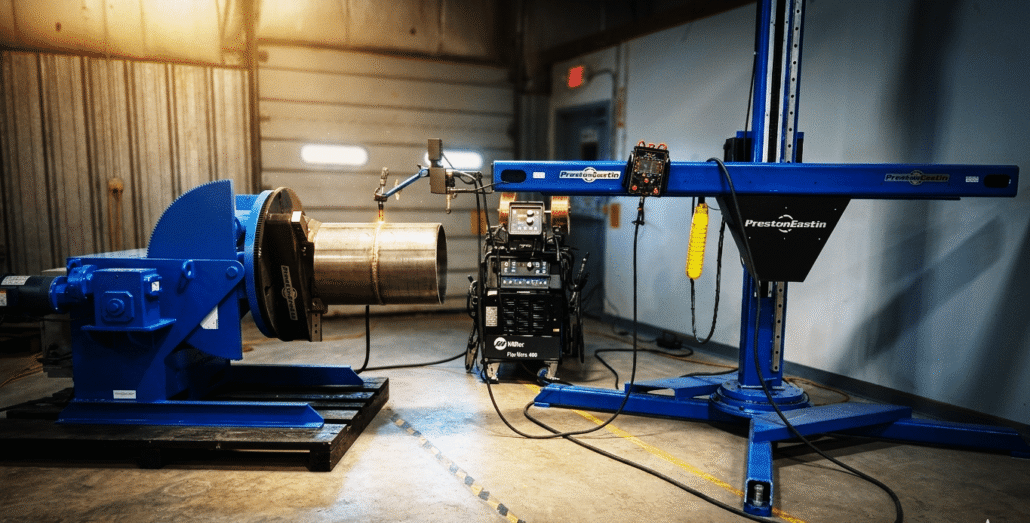
The Integrated Pipe Welding System (IPWS), developed through a collaboration between Preston Eastin and Steelmax, both members of the SMX family of companies, was built on that premise. Before you can control a weld, you have to control the part.
The IPWS brings together precision positioning, controlled manipulation, programmable oscillation, and full welding power in a single unified system. Not components sourced from separate suppliers and made to work together after the fact. One system, designed from the start to operate as one.
Here’s what that means in practice. A Preston Eastin X-Y manipulator positions the torch with accuracy that’s repeatable across every joint, every shift, every operator. A PE30 tilt-rotate positioner or HE-50 elevating headstock controls part rotation with the precision that eliminates the guesswork of manual repositioning. Add the Steelmax Linear Oscillator — which gives you programmable control over bead shape, travel speed, and torch oscillation — and you can run root, hot, fill, and cap passes with a level of consistency that manual processes can’t sustain at volume.
When the part is properly positioned and the torch is under controlled movement, variation comes out of the equation. Weld profiles become predictable. Defects become rare rather than routine. Rework stops being an assumed line item and starts being an exception.
There’s a human dimension to this that matters, too. Manual pipe welding at volume is physically demanding. Fatigue accumulates, and with it comes the kind of inconsistency that leads to defects and rework. The IPWS shifts the operator’s role from constant physical adjustment to oversight and control. That’s not a reduction in skill. It’s a better application of it.
In today’s fabrication environment, where teams are being asked to produce more with the workforce they have, that distinction matters. Systems like the IPWS aren’t a replacement for expertise. They’re how experienced operators extend their capacity.
From a procurement standpoint, the IPWS arrives as a turnkey solution. The manipulator, positioner, oscillation system, and the complete Miller PipeWorx 400 welding package — all configured to work together, all delivered as one. No vendor coordination. No compatibility troubleshooting. No integration risk.
The industries where this matters most are the ones where pipe and vessel welding are central to the work: data center infrastructure, oil and gas pipe fabrication, power generation, shipbuilding, and heavy equipment manufacturing. In each case, the requirement is the same: precise welds, produced consistently, at a pace that meets production demands.
Preston Eastin has spent more than 50 years building the positioning and manipulation systems that fabricators rely on for exactly that kind of work. The IPWS is what happens when that expertise connects directly with the torch control and oscillation technology of Steelmax — not as a sales bundle, but as a purpose-built integrated system.
The logic runs in one direction. Control the part. Control the torch. Control the outcome.
Positioning is where that chain starts. The IPWS is built around that idea.


Leave a Reply
Want to join the discussion?Feel free to contribute!